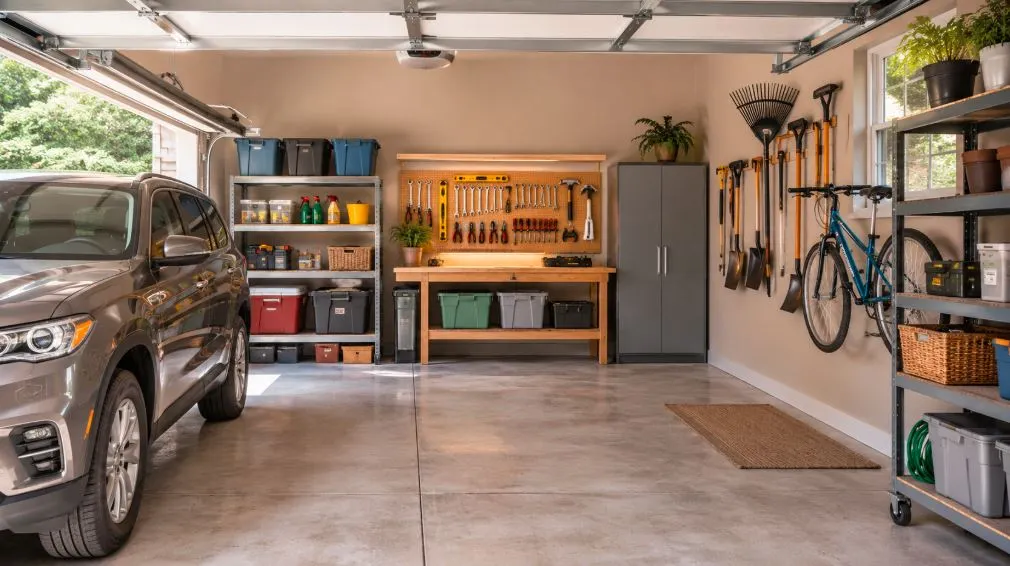
A garage can quickly become the place where everything without a proper home ends up. Gardening tools lean against the walls, holiday decorations disappear behind boxes, and finding a screwdriver turns into a ten-minute search. Eventually, even parking the car becomes difficult.
Knowing how to organize a garage starts with deciding what belongs there, removing unnecessary items, and creating storage zones around your daily habits. The goal is not to fill every wall with shelves or buy dozens of matching containers. It is to make everything easier to find, use, and put away.
Whether you have a small one-car garage, a shared family garage, or a larger space filled with years of clutter, the following steps will help you build an organization system that fits your space and budget.
1. Decide What Your Garage Needs to Do
Before moving boxes or buying storage cabinets, think about how the garage should function once it is organized.
For some households, parking is the main priority. Others need space for a workbench, gardening equipment, bicycles, or outdoor gear. A garage that serves several purposes needs a layout that keeps those activities from getting in each other’s way.
Start by identifying your priorities:
- Parking one or more vehicles
- Storing household tools and DIY supplies
- Keeping gardening and lawn equipment accessible
- Organizing sports equipment and bicycles
- Storing seasonal decorations and camping gear
- Creating a small workshop
If parking is essential, treat the vehicle area as protected space rather than leftover room after storage. Leave enough clearance to open car doors, walk around the vehicle, and carry groceries into the house.
Take a few photos of the current garage. They can help you identify wasted corners, crowded walkways, and areas where clutter tends to collect.
2. Declutter Before Buying Storage
Adding shelves to an overcrowded garage without removing unnecessary items often creates a more expensive version of the same problem.
Start with one section of the garage. If space and weather allow, move manageable groups of belongings onto the driveway. For a heavily cluttered garage, working in smaller sections makes the project less overwhelming.
Sort ordinary belongings into five categories:
- Keep: Items you regularly use or have a genuine reason to store.
- Donate: Useful belongings that someone else could benefit from.
- Sell: Equipment, tools, or furniture that still holds value.
- Discard or recycle: Broken, damaged, or unusable nonhazardous items.
- Relocate: Things that belong elsewhere in the house.
Be realistic about duplicate tools, unfinished projects, broken equipment, and boxes that have remained unopened for years.
An item does not deserve garage space simply because it might be useful someday. Consider whether replacing it would be difficult and whether keeping it prevents you from storing something more important.
Deal With Old Paint, Chemicals, and Batteries Separately
Not everything can go into ordinary household trash. Leftover paint, pesticides, motor oil, certain batteries, and other potentially hazardous products may require special disposal.
The Environmental Protection Agency’s household hazardous waste guidance recommends handling these materials carefully and checking local disposal options.
Keep products in their original labeled containers. Never mix leftover chemicals or pour them into drains.
3. Clean the Garage and Measure the Available Space
An emptier garage makes it much easier to spot problems that were previously hidden behind boxes.
Sweep or vacuum the floor, remove ordinary dust from shelves, and check corners for moisture, pests, or signs of water entering the garage.
Clean oil stains with a suitable concrete cleaner according to its instructions. Allow damp surfaces to dry before returning storage containers.
Once the area is clean, measure the available storage space.
Pay attention to:
- Wall length and usable height
- Garage door tracks and opener clearance
- Electrical outlets and switches
- Windows and entry doors
- Vehicle dimensions
- Water heaters and other utility equipment
- Available walkway space
Measure with the car parked inside, if practical. A wall may appear to have plenty of room until the car door needs to open beside it.
You can apply the same clearance principles used when measuring a room for furniture to avoid buying garage shelves or cabinets that are too large.
If the garage has an ongoing moisture problem, address the cause before installing permanent storage. Plastic containers can protect some belongings, but they cannot solve a leaking roof or water entering through the walls.
4. Create Garage Storage Zones
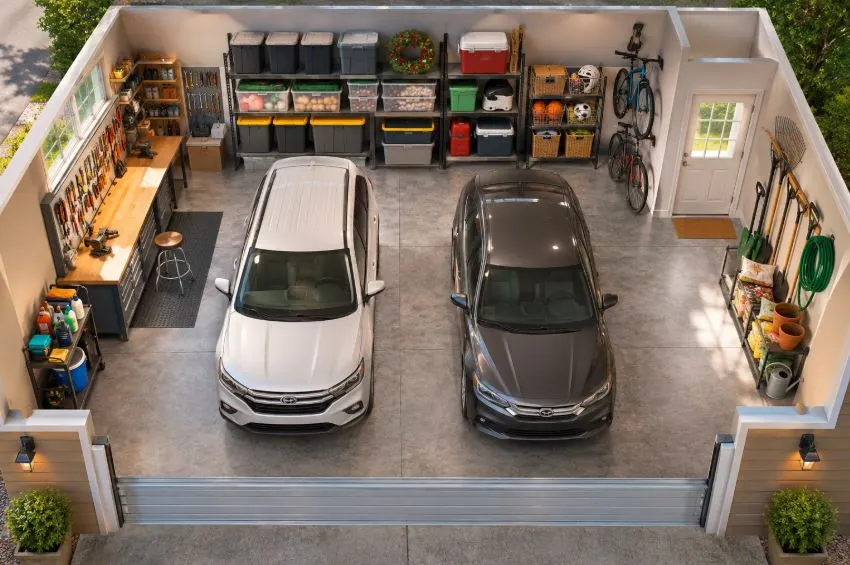
Dividing a garage into storage zones is one of the most effective ways to keep it organized.
Instead of placing belongings wherever they fit, give each category a dedicated location. Group items according to how and where they are used.
| Storage Zone | Items to Store | Suitable Location |
|---|---|---|
| Tools and DIY | Hand tools, drills, hardware, measuring tools | Near the workbench |
| Gardening | Rakes, shovels, pots, garden accessories | Near the outdoor exit |
| Sports equipment | Balls, helmets, rackets, bicycles | Accessible side wall |
| Seasonal storage | Holiday decorations, camping accessories | Upper shelves |
| Car care | Microfiber cloths, brushes, suitable accessories | Near the parking area |
| Household supplies | Garage-safe cleaning equipment and spare household items | Shelving or cabinets |
| Everyday essentials | Reusable bags, umbrellas, frequently used outdoor items | Near the house entrance |
The exact zones will depend on your household. A family with young children may need more space for sports equipment, while someone who enjoys woodworking may need a larger tool and workshop area.
Organize Items by How Often You Use Them
Storage height matters as much as storage location.
Keep frequently used items between waist and shoulder height whenever practical. Store heavy equipment on sturdy lower shelves or at floor level in a designated area. Higher shelves are better suited to lightweight belongings that only come out occasionally.
Think about the effort required to retrieve something.
If getting a bicycle means moving three boxes and a lawn mower, the bicycle is stored in the wrong place. Frequently used items should have an easy route in and out of the garage.
5. Choose the Right Garage Storage Solutions
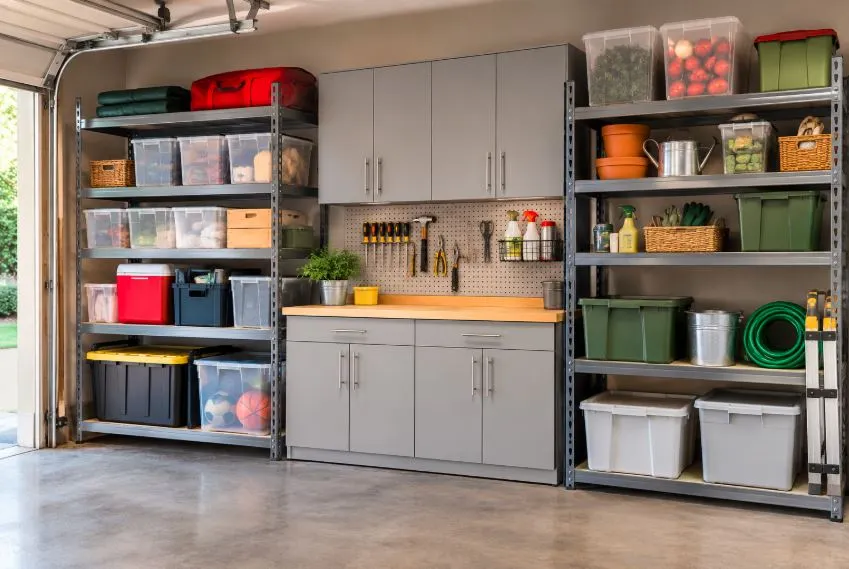
Not every garage needs a complete storage system. Some spaces benefit from open shelving, while others need wall-mounted organizers or closed cabinets.
Choose storage based on the belongings that remain after decluttering.
| Storage Type | Best For | Main Limitation |
|---|---|---|
| Open shelving | Storage bins, bulky items, everyday supplies | Items collect dust and remain visible |
| Closed cabinets | Smaller supplies and visually cluttered items | Doors need opening clearance |
| Pegboards | Frequently used hand tools | Limited by board and hook weight ratings |
| Slatwall panels | Adjustable hooks, baskets, and accessories | Higher initial cost |
| Wall-mounted racks | Bicycles, ladders, and garden tools | Require secure installation |
| Overhead racks | Lightweight, rarely used seasonal items | Difficult to access |
| Rolling carts | Tools and supplies used in different locations | Take up floor space |
| Stackable bins | Categorized belongings and seasonal storage | Lower containers can be difficult to reach |
A combination usually works better than relying on one storage method throughout the garage.
Install Shelves That Fit Your Belongings
Garage shelving units are particularly useful because they create several storage levels without taking up additional wall length.
Adjustable shelves offer more flexibility than fixed shelves. The spacing can change as your storage needs change, and tall containers do not have to leave large gaps above smaller ones.
Metal shelving can work well for heavy garage equipment when properly rated. Plastic shelving may suit lighter belongings, while wooden shelves can be practical in a dry garage when designed and supported for the intended load.
Check both the individual shelf capacity and the total unit capacity before loading a shelving system. Follow the manufacturer’s assembly and anchoring instructions.
Deep shelves work well for large storage totes, but small objects tend to disappear toward the back. Use shallow containers or smaller labeled bins to keep those items visible.
Use Closed Cabinets Where Open Storage Becomes Messy
Open shelves make items easy to see, but a garage filled with loose containers, cables, and hardware can still look cluttered.
Closed cabinets are useful for grouping smaller garage-safe supplies. They also provide some protection from dust and create a cleaner appearance.
However, putting everything behind doors can make belongings harder to remember. Reserve open storage for items you reach for regularly, and use cabinets for categories that benefit from being contained.
Lockable storage may also help restrict children’s access to sharp tools and other unsuitable items.
6. Make Better Use of Garage Walls
The floor is often the most valuable part of a garage, especially when vehicles share the space with storage.
Using vertical garage storage helps move awkward belongings away from walkways and parking areas.
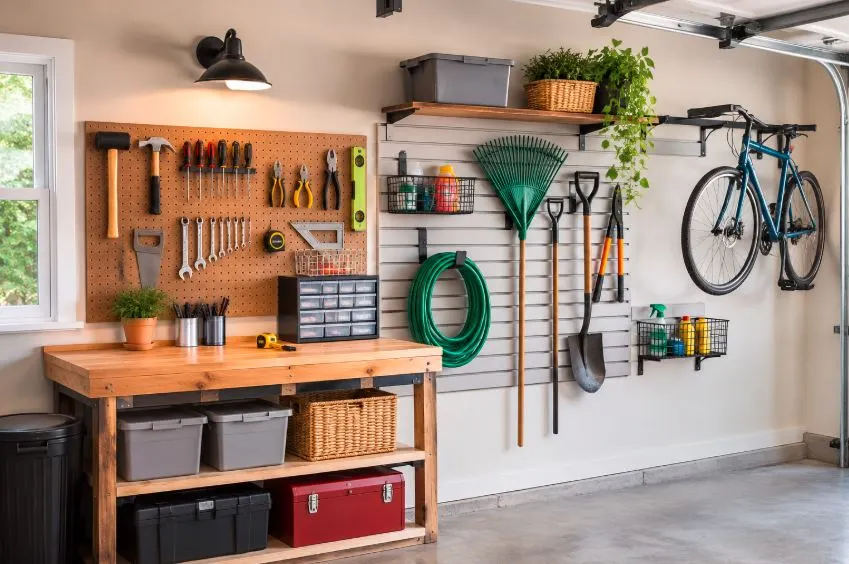
Use a Pegboard for Hand Tools
A pegboard works particularly well above a workbench because it keeps tools visible without using the work surface.
Arrange screwdrivers, pliers, wrenches, measuring tapes, and other frequently used tools according to their size and purpose.
Leave enough room between tools so one can be removed without knocking another off its hook. Heavier equipment needs storage hardware specifically rated for its weight.
Install Wall Tracks or Slatwall Panels
A slatwall is a panel with horizontal channels that hold compatible hooks, baskets, and shelves. Wall track systems work in a similar way.
Both allow storage arrangements to change without installing a separate fixture for every object.
They can be useful for households with changing sports equipment, gardening supplies, or outdoor accessories. A traditional pegboard may be the more affordable option if the main requirement is storing a small collection of hand tools.
Give Long and Awkward Items Their Own Storage
Rakes, shovels, ladders, hoses, and folding chairs often create clutter because they do not fit neatly inside ordinary containers.
Suitable wall-mounted holders can keep long-handled tools together. Secure ladder racks and bicycle mounts can free additional floor space.
Install all load-bearing wall storage using suitable structural supports and hardware. Do not assume ordinary drywall anchors can safely carry heavy equipment.
7. Reserve Overhead Storage for Items You Rarely Need
The space near the garage ceiling can provide extra storage without reducing usable floor space.
Overhead garage storage is most suitable for lightweight, bulky belongings such as empty luggage, certain camping accessories, and seasonal decorations that tolerate garage temperatures.
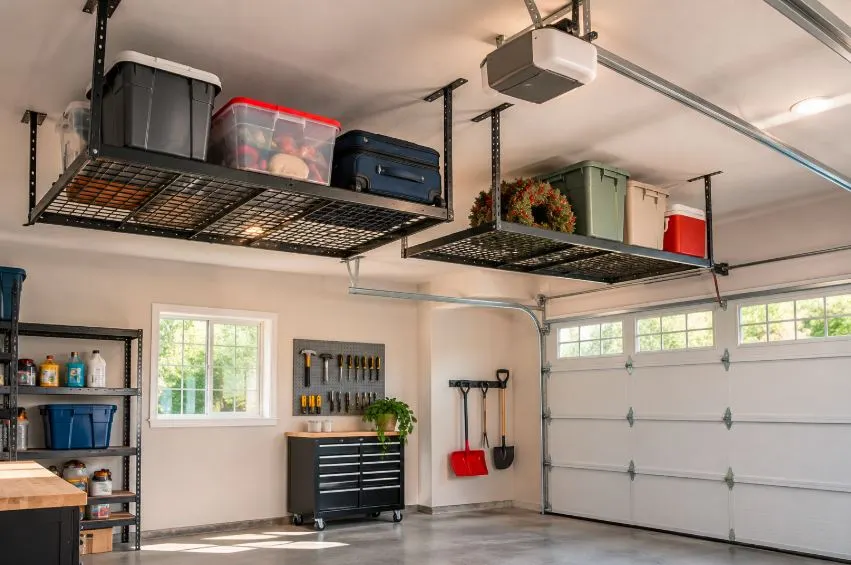
It is less convenient for everyday tools, heavy boxes, or anything that requires frequent access.
Before installing ceiling-mounted storage, check the garage door’s full movement, the opener, ceiling lights, and the structure supporting the rack.
Overhead racks must be installed according to their rated capacity and manufacturer requirements. If you are unsure whether the ceiling structure can support the load, consult a qualified installer.
In a garage with a low ceiling, upper wall shelves may be a simpler and more accessible alternative.
8. Organize Garage Tools, Sports Gear, and Outdoor Equipment
Different belongings need different types of storage. A large plastic tote might work for camping accessories but would be frustrating for a collection of small hand tools.
Tools and Workshop Supplies
Keep everyday hand tools near the workbench or main working area.
A tool chest with shallow drawers works well for sockets, drill bits, and smaller accessories. Drawer dividers prevent different sizes of hardware from becoming mixed together.
Store screws, nails, washers, and other small parts in labeled compartment boxes.
Power tools should have stable storage that protects them from moisture and accidental falls. Follow the manufacturer’s guidance for storing tools, chargers, and rechargeable batteries.
Keep the workbench itself mostly clear. It should remain available for projects rather than becoming another permanent storage surface.
Gardening and Lawn Equipment
Store garden tools near the door leading outdoors, where the layout allows.
Keep long-handled tools in suitable wall holders and smaller accessories together in a basket or container. Empty soil from pots and allow damp equipment to dry before storing it.
Give larger equipment, such as a lawn mower or wheelbarrow, a dedicated floor position that does not block the vehicle or pedestrian route.
Follow equipment manuals for fuel, battery, and long-term storage requirements.
Bicycles and Sports Equipment
Families often need sports equipment to be accessible without involving an adult every time.
Open baskets work well for lightweight balls and other frequently used items. Hooks can hold helmets and suitable accessories.
For bicycles, choose between a floor stand, wall-mounted rack, or another properly rated storage system based on available space.
A bicycle stored vertically may save floor space, but lifting it onto a high hook can be inconvenient for children or anyone with limited strength. Everyday accessibility is often more important than squeezing every item onto the wall.
Seasonal Decorations and Camping Gear
Group seasonal belongings by occasion or activity instead of mixing unrelated items into large containers.
For example, keep Christmas decorations separate from summer camping equipment.
Use containers that suit the garage environment, and label them clearly. Delicate decorations, family photographs, and temperature-sensitive belongings may need storage inside the house instead.
9. Label Containers So Nothing Gets Lost Again
An organized garage becomes difficult to maintain when nobody remembers what is inside each box.
Clear plastic storage bins are useful because they allow some visibility without opening the lid. Opaque containers can create a more uniform appearance, but they depend more heavily on labels.
Use specific labels such as:
- Camping accessories
- Christmas lights
- Bicycle accessories
- Painting tools
- Plumbing fittings
- Garden supplies
Avoid vague labels such as “Miscellaneous” or “Extra Stuff.” Those categories tend to collect unrelated belongings.
Place labels on the side facing the walkway rather than only on the lid. This makes containers easier to identify when they are on shelves.
For a garage with many seasonal boxes, a simple inventory on your phone can save time. Numbering containers and recording their contents is particularly useful for items stored out of sight.
How to Organize a Small Garage Without Losing Parking Space
A small garage needs a slightly different approach because every storage decision affects how easily the space can be used.
Start by identifying the wall that offers the most storage space without interfering with car doors or the garage entrance.
Shallow shelving may work better along the sides of a one-car garage, while deeper shelving could fit against the back wall if the vehicle leaves enough clearance.
Consider these space-saving arrangements:
- Wall-mounted storage for long-handled tools.
- Narrow shelving for smaller containers.
- Upper wall shelves for lightweight seasonal belongings.
- Folding workbenches where suitable supports and clearance are available.
- Compact bicycle racks that do not block walkways.
- Stackable containers for less frequently used items.
Avoid filling both side walls with deep shelving unless the actual garage dimensions allow it.
In a two-car garage, the narrow area between vehicles should remain clear enough for occupants to enter and exit comfortably. Storage along the perimeter is generally more practical than introducing a central cabinet or shelving unit.
A small garage also benefits from keeping fewer duplicate items. Removing one unnecessary storage bin may create more usable space than buying another organizer.
How to Organize a Garage on a Budget
An expensive garage makeover is not necessary to create a functional space.
The most affordable improvements usually come from removing clutter, rearranging existing storage, and solving individual problems rather than purchasing a matching cabinet system.
| Common Problem | Budget-Friendly Solution |
|---|---|
| Small tools are scattered | Reuse suitable compartment boxes or drawer organizers |
| Storage boxes are difficult to identify | Add simple handwritten labels |
| Garden tools occupy floor space | Install suitable rated tool holders |
| Existing shelves look messy | Group belongings into smaller containers |
| Hardware is mixed together | Use labeled divided containers |
| Seasonal items occupy prime storage | Move lightweight items to suitable upper shelves |
Before buying anything, spend a few days using the newly arranged garage.
The missing storage solution will often become obvious. Perhaps the garden tools need a dedicated holder, or the existing shelves need smaller containers rather than replacement.
Secondhand shelving can also reduce costs, provided it is stable, undamaged, suitable for the intended load, and installed safely.
Rental-Friendly Garage Organization
Renters may not have permission to install permanent cabinets, drill into walls, or attach ceiling racks.
Freestanding shelving, stable floor-standing organizers, rolling tool carts, and suitable storage containers can provide flexibility without major alterations.
However, freestanding does not automatically mean anchoring is unnecessary. If a shelving unit requires wall anchoring for safety, obtain permission to install it properly or choose a different storage system that meets your needs without unauthorized modifications.
What Should You Avoid Storing in a Garage?
Garages often experience greater temperature changes and humidity than indoor living spaces. These conditions can damage certain belongings or create safety concerns.
| Item | Why Garage Storage May Be Unsuitable |
|---|---|
| Family photographs and documents | Moisture and temperature changes can cause damage |
| Food and pet food | Heat, humidity, and pests may affect storage quality |
| Delicate fabrics | Damp conditions can encourage mold and musty odors |
| Sensitive electronics | Temperature extremes and moisture may cause damage |
| Gasoline and propane cylinders | Fire and explosion hazards |
| Certain paints and chemicals | Flammability or unsuitable storage temperatures |
| Valuable wooden furniture | Changes in humidity can affect wood |
The U.S. Fire Administration’s garage fire safety guidance advises storing flammable products such as gasoline, propane, oil, paints, and varnishes in a suitable shed away from the home.
Follow product labels and local fire safety requirements when selecting an alternative storage location.
Keep combustible clutter away from heat-producing equipment. Electrical panels, utility equipment, ventilation openings, garage door mechanisms, and emergency exit routes should remain unobstructed.
Common Garage Organization Mistakes That Waste Space
Even a garage with plenty of storage can become difficult to use if the layout does not match everyday habits.
Buying storage before decluttering. This often leads to oversized cabinets or unnecessary shelving for belongings that should have been removed.
Storing everyday items too high. Frequently used equipment becomes inconvenient to retrieve, which makes it less likely to be returned properly.
Stacking too many containers. If reaching the bottom box requires moving several others, the storage arrangement is not practical for regularly used belongings.
Ignoring future storage needs. Filling every shelf immediately leaves no room for seasonal changes or new equipment.
Using the floor as temporary storage. Boxes left in walkways often become permanent obstacles.
Choosing appearance over accessibility. Matching containers may look tidy, but a garage needs to function as well as it looks.
A well-organized garage does not have to resemble a professionally designed showroom. It needs a layout that the people using it can maintain.
Keep Your Garage Organized Throughout the Year
Garage organization becomes easier to maintain when returning an item requires little effort.
Set aside a few minutes each week to put tools, sports equipment, and other belongings back in their assigned places.
Once a month, check whether any containers are overflowing or whether objects are beginning to collect on the floor.
Seasonal changes offer another opportunity to review storage. Move frequently used outdoor equipment into accessible positions and return out-of-season belongings to their designated shelves.
Before bringing a new item into the garage, decide where it will live.
If its category has already outgrown the available storage, consider removing an unused item before expanding the storage system.
Leave some empty shelf space whenever possible. A little flexibility makes it easier to handle changes without disrupting the entire garage.
A Weekend Garage Organization Checklist
A full garage cleanout does not have to happen in a single day. For a manageable garage, dividing the project across a weekend can make it easier to complete.
Saturday: Clear and prepare
- Decide the main purpose of the garage.
- Declutter one storage area at a time.
- Separate donations and unwanted belongings.
- Arrange suitable disposal for hazardous waste.
- Clean the floor and existing shelves.
- Measure usable storage space.
- Plan storage zones.
Sunday: Organize and arrange
- Set up suitable shelving and organizers.
- Group tools and equipment by category.
- Label storage containers.
- Place heavy belongings in stable lower storage.
- Assign space for seasonal items.
- Check parking and walkway clearance.
- Confirm everything can be retrieved easily.
A heavily cluttered garage or a project requiring professional installation may take several weekends. Completing one area properly is more useful than rushing through the whole space.
Frequently Asked Questions
What is the best way to organize a garage?
The best way to organize a garage is to remove unnecessary belongings, divide the remaining items into storage zones, and choose storage according to weight, size, and frequency of use. Use suitable wall storage to free floor space and keep everyday items easy to reach.
Where should I start when my garage is overwhelming?
Start by clearing a safe walkway and removing obvious rubbish from one manageable section. Once that area is clear, use it as a sorting space for the next section. Avoid emptying the entire garage at once if you cannot safely manage the contents.
Is open or closed garage storage better?
Open shelving is better for visibility and quick access, while closed cabinets help control dust and conceal smaller, visually cluttered belongings. Combining both types usually creates a more practical garage.
How deep should garage shelves be?
Garage shelf depth should match the belongings being stored and the available clearance around vehicles and walkways. Shallow shelves suit smaller tools and containers, while larger storage totes may need deeper shelving. Measure both the items and the available garage space before purchasing.
Can I organize a garage without spending money?
Yes. Start by removing unused belongings, rearranging existing shelves, reusing suitable containers, and creating dedicated storage zones. Handwritten labels and better placement can improve organization without buying new equipment.
How long does it take to organize a garage?
A lightly cluttered garage may take a few hours, while a garage containing years of accumulated belongings may require several days or weekends. The amount of sorting, disposal, cleaning, and installation involved determines the time needed.
Build a Garage That Stays Useful
Learning how to organize a garage is less about finding room for everything and more about deciding what deserves the space.
Start with the belongings that regularly interrupt your routine. Clear the crowded walkway, give frequently used tools a permanent location, and make sure the car can enter and leave without moving storage boxes.
Add shelving, cabinets, or wall organizers only where they solve a genuine problem. A smaller, thoughtfully arranged storage system can be more useful than a garage filled with expensive equipment.
The real measure of an organized garage is simple: you should be able to find what you need, use it, and return it without rearranging everything around it.