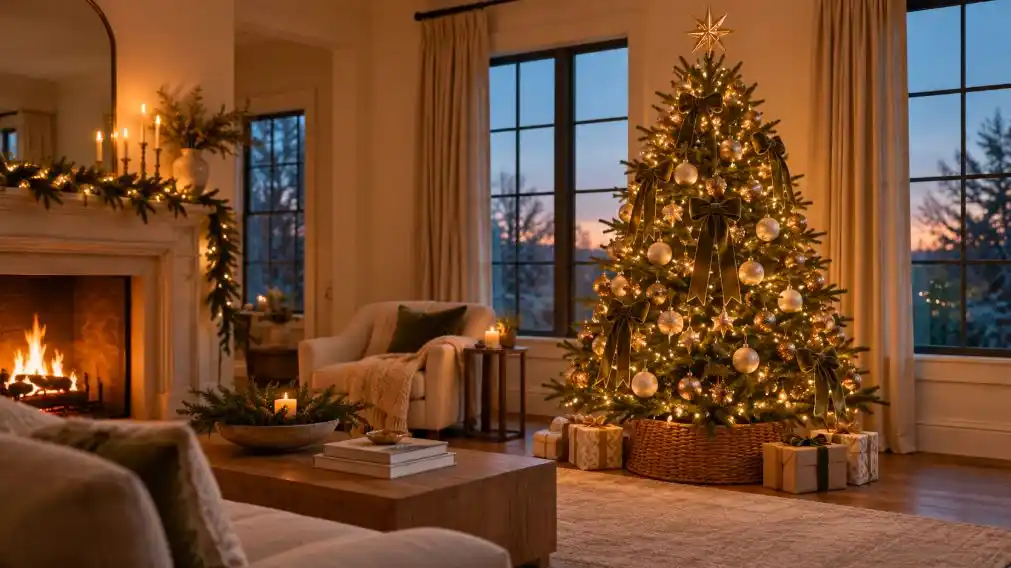
A tree with lovely ornaments can still look messy if the lights are patchy, the colors fight each other, or everything is hung on the outer tips. The best Christmas tree decorating ideas start with a plan: a color story, the right amount of light, and a simple order for adding each layer.
Below you will find themes and palettes to choose from, the order that professional-looking trees follow, how many lights to buy for your tree height, and ideas for small spaces, rentals and homes with kids or pets.
Pick a Color Story Before You Open the Boxes
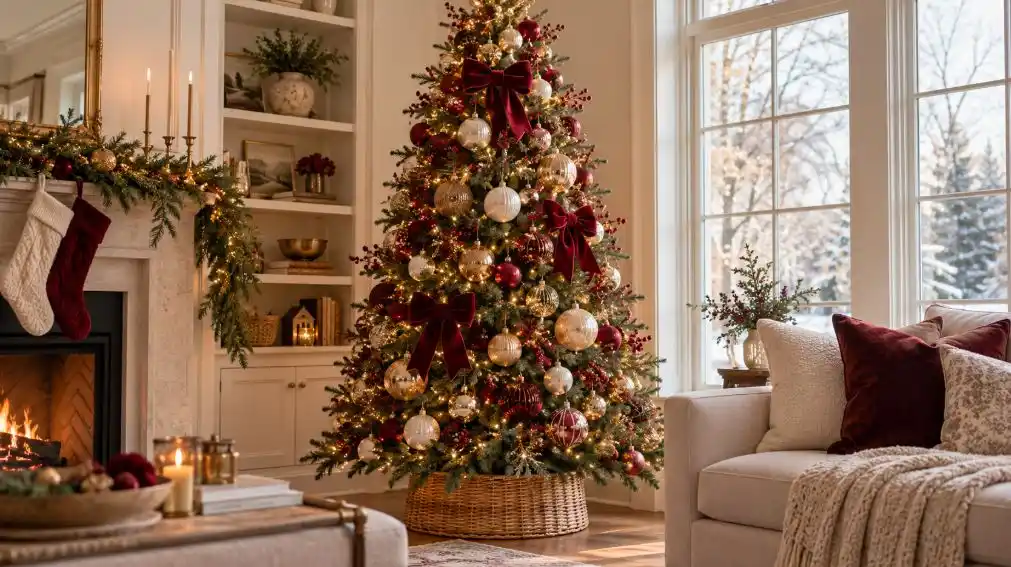
Two or three main colors, plus one metal finish, is enough for most trees, and it is the first decision behind almost all good Christmas tree decorating ideas. More than that tends to look busy unless you are going for an intentionally colorful, maximalist look. A clear palette also tells you which ornaments to leave in the box, which matters more than buying new ones.
These are popular directions right now, along with what each one needs:
| Theme | Colors and materials | Light color | Suits |
|---|---|---|---|
| Classic red and gold | Red and gold glass baubles, plaid or velvet ribbon, pinecones | Warm white | Traditional living rooms, family trees with heirlooms |
| Burgundy and aged gold | Deep red, wine and plum tones with antique brass or matte gold, velvet bows | Warm white | Rooms with wood furniture, darker walls or leather |
| Natural or woodland | Dried orange slices, cinnamon sticks, wood bead garland, felt animals, raw pinecones | Warm white | Farmhouse, rustic and Scandinavian rooms |
| Scandi minimal | White, cream and natural wood, paper stars, a few clear glass baubles | Warm white, kept soft | Small apartments and calm, neutral spaces |
| Tartan and plaid | Plaid ribbon and bows, red and green, wooden or felt ornaments | Warm white or multicolor | Cabins, dens and family rooms |
| Frosted silver and blue | Silver, ice blue and white, mercury glass, faux snow | Cool white | Modern rooms with gray or white walls |
| Colorful and nostalgic | Mixed bright glass, vintage-style ornaments, tinsel or bead garland | Multicolor | Kids’ rooms and playful, maximalist homes |
Let the room guide the choice. A tree in a beige living room can carry stronger color than the room around it, while a tree in front of a bold wallpaper usually looks better in a quieter palette. If you have decorated the rest of the house already, repeat one color from there so the tree feels connected. Our guide to Christmas decor ideas for every room covers the mantel, table and entry, and pairs well with any theme above.
Decorate in This Order for a Finished Look
Most trees that look “styled” follow the same order. Each layer has its own job, and doing them out of sequence is the main reason ornaments end up hidden or lights end up tangled behind garland.
- Shape the branches. On an artificial tree, fluff every branch tip outward and slightly upward, working from the trunk to the tips. Skipping this step leaves visible gaps that no ornament can hide.
- Add the lights. Lights always go first, while you can still reach deep into the tree.
- Add ribbon, garland or beads. These create the movement and structure the ornaments sit around.
- Hang the largest ornaments. Space them evenly, including a few tucked deeper toward the trunk.
- Fill with medium and small ornaments. Use them to balance color and cover small gaps.
- Add picks and sprays. Berry stems, frosted branches or dried florals add texture and fill holes.
- Finish with the topper and base. Do these last so they are sized to the finished tree.
Step back every few minutes and look at the tree from across the room, and squint slightly. Squinting blurs the detail so you see gaps and color clumps right away.
How Many Lights Does a Christmas Tree Need?
A common guideline is about 100 mini lights per vertical foot (about 30 cm) of tree. Use fewer for a soft, minimal glow and more for a bright, full look. Larger bulbs or wide-angle LEDs give off more light each, so you need fewer of them.
| Tree height | Soft glow (about 50 per ft) | Standard (about 100 per ft) | Extra bright (about 150 per ft) |
|---|---|---|---|
| 4 ft (1.2 m) | 200 | 400 | 600 |
| 6 ft (1.8 m) | 300 | 600 | 900 |
| 7.5 ft (2.3 m) | 375 | 750 | 1,125 |
| 9 ft (2.7 m) | 450 | 900 | 1,350 |
A full, wide tree needs more lights than a slim tree of the same height, so treat the table as a starting point. Before you buy, check the product label for how many strings can be connected end to end, and never exceed it.
How you wrap matters as much as the count. Instead of spiraling lights around the outside like a candy stripe, work in vertical sections from the bottom up: run the string along a branch toward the trunk and back out to the tip, then move to the next branch. This lights the tree from inside as well as on the surface, which is what gives a tree depth.
Warm white bulbs suit most homes and match the warm color of most indoor lighting. The same warm color temperature that makes a room feel restful, covered in our warm aesthetic cozy bedroom guide, also keeps a tree from looking harsh at night. Cool white works best for silver, blue and frosted themes.
Christmas Tree Decorating Ideas With Ornaments
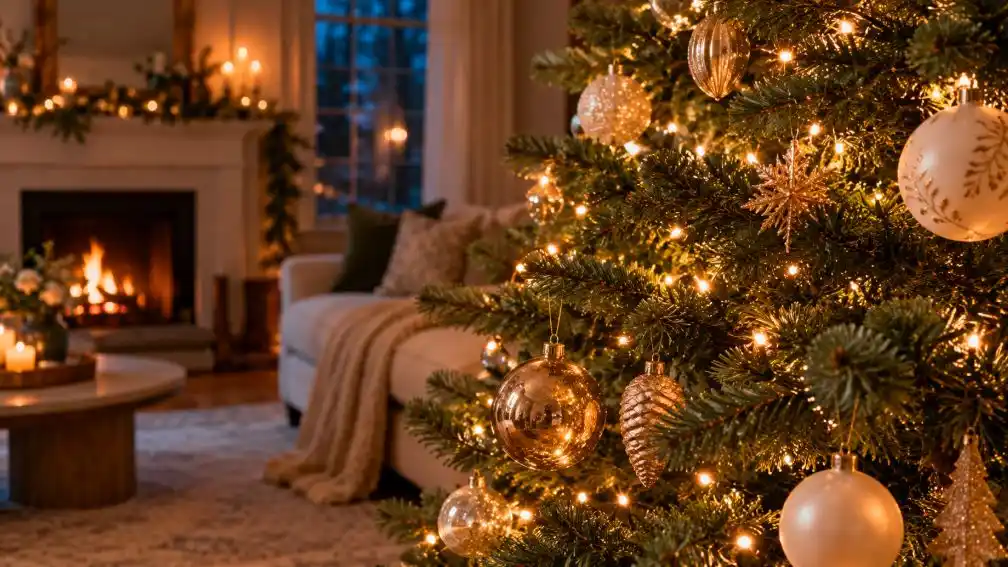
Ornaments look intentional when they are placed with variety in size and depth, not just spread evenly across the surface.
- Use three sizes. Large ornaments set the color, medium ones balance it, and small ones fill gaps. A tree of only small ornaments looks busy; a tree of only large ones looks sparse.
- Go deep, not just wide. Hang some ornaments a hand’s length inside the branches. Those inner pieces catch the light and make the tree look fuller.
- Group in odd numbers. Clusters of three matching baubles on one branch read as deliberate and help a small ornament collection look bigger.
- Put special pieces at eye level. Heirlooms and handmade ornaments are best where people actually look, roughly in the middle third of the tree.
- Mix finishes. Combining shiny, matte and glitter ornaments in the same color adds interest without adding new colors.
If your collection is a mix of unrelated pieces, choose two colors from it and group those first. The odd ones out can go on a smaller second tree, a wreath or a garland elsewhere.
Ribbon, Bow and Garland Ideas
Ribbon is one of the easiest ways to make an inexpensive tree look tailored, and bows have become one of the most popular Christmas tree decorating ideas in recent seasons.
Waterfall ribbon. Cut lengths of wired ribbon and tuck them vertically from the top of the tree downward, pushing short loops into the branches every 8 to 12 in (20 to 30 cm). Wired ribbon holds its shape, while unwired ribbon tends to slump.
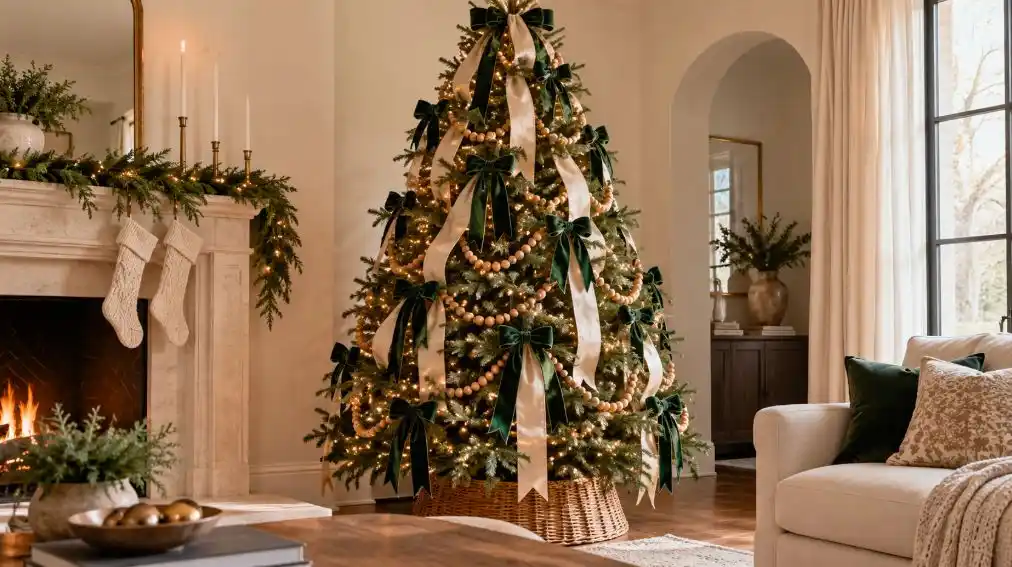
Bows on branch tips. Repeat one bow style and color around the tree. Velvet bows in deep red, green or cream suit most themes, and they can replace ornaments almost entirely on a minimal tree.
Bead or wood garland. Drape it in loose swags from branch to branch rather than wrapping it tightly, so it looks soft instead of strapped on.
Tinsel and lametta. These add sparkle to a colorful, nostalgic tree. Skip them in homes with cats, since pets may chew and swallow strands.
Christmas Tree Decorating Ideas for Small Spaces and Rentals
A full-size tree is not the only way to have a festive corner. Small rooms often look better with a scaled-down option that leaves space to walk.
- Slim or pencil trees take up much less floor space than a full tree of the same height.
- Tabletop trees on a console, sideboard or sturdy dresser keep the floor clear and are easy to store.
- Wall trees made from lights, garland or branches attached with removable hooks suit rentals where floor space is tight.
- Flat-back decorating. If the tree sits in a corner, put most ornaments on the front and sides people see, and use leftover lights and plain baubles at the back.
Before buying a tree, measure the floor space and the ceiling height. Subtract the height of the stand and the topper, then leave a few inches of clearance below the ceiling. The same habit used to measure a room for furniture, sketching the corner, the walking path and nearby outlets, stops a tree from blocking a doorway or a radiator.
Toppers and the Tree Base
The top and bottom of the tree frame everything in between, and both are easy to get wrong in size.
A topper should be in proportion to the tree. A tiny star disappears on a 9 ft tree, while a large one can make a small tree look top-heavy. Check how the topper attaches: some need a straight central stem, and heavy toppers may need a few zip ties or floral wire to stay upright. A bow, a cluster of picks or a burst of ribbon can replace a traditional star.
At the base, choose a tree skirt no wider than the spread of the lowest branches, or a tree collar (a basket, metal or wooden ring) for a neater, modern look. Collars also hide the stand and cords, and are easier to vacuum around. Gift boxes wrapped in your tree colors can double as decoration in the weeks before the holiday.
Decorating With Kids and Pets in the House
A few changes keep the tree festive without becoming a hazard:
- Keep glass and breakable ornaments on the upper half, and use shatterproof, felt, wood or fabric ornaments on the lower branches.
- Avoid small, removable decorations within reach of young children, and avoid sharp or weighted ornaments, as the U.S. Consumer Product Safety Commission recommends.
- Secure a tall tree to the wall with a discreet hook and clear line if a toddler or large dog might pull on it.
- Route and cover cords so they are not trip hazards or chew targets.
- Use ribbon and wood bead garlands instead of tinsel when cats are around.
Decorating a Real Tree vs an Artificial Tree
The Christmas tree decorating ideas above work for both, but each type needs a slightly different approach.
A real tree has softer, more open branches, so lighter ornaments work best near the tips, and heavier pieces go closer to the trunk where branches are stronger. A fresh tree has green needles that are hard to pull off the branches. Keep the stand filled with water every day and place the tree away from fireplaces, radiators, heaters and candles, since a dry tree catches fire easily.
An artificial tree needs careful fluffing before anything else, and it can hold heavier ornaments. If you are buying one, look for a “Fire Resistant” label, which means the tree resists burning, not that it cannot burn. With either type, use lights tested by a recognized lab such as UL, check each string for damaged wires before use, and turn the tree lights off at bedtime and when you leave the house.
Frequently Asked Questions
What do you put on a Christmas tree first?
Lights go on a Christmas tree first, followed by ribbon or garland, then the largest ornaments, smaller ornaments, picks and finally the topper. On an artificial tree, fluff the branches before adding the lights.
How many lights do you need per foot of Christmas tree?
A common guideline is about 100 mini lights per vertical foot of tree, so a 7.5 ft tree needs around 750. Use about 50 per foot for a soft look and up to 150 per foot for a very bright tree.
How do you make a Christmas tree look expensive?
A Christmas tree looks more expensive with a limited color palette, plenty of lights woven deep into the branches, wired ribbon or bows, and ornaments in three sizes placed at different depths. Fluffing every branch and finishing the base with a collar also make a big difference.
When should you put up a Christmas tree?
Many households in the US decorate the weekend after Thanksgiving, while early December is common in the UK, Canada and Australia. A fresh-cut tree lasts longer if it goes up later and is watered daily, so artificial trees suit people who like to decorate early.
How do you put ribbon on a Christmas tree?
Cut wired ribbon into lengths and tuck it into the branches in vertical “waterfall” lines from the top down, pinching a loop into the tree every 8 to 12 in. Alternatively, tie bows and place them on branch tips around the tree.
Finishing Touches Before the Lights Go On at Night
Once everything is on, switch off the room lights and look at the tree in the dark. Dark patches usually mean a light string needs moving deeper, and bright clumps mean ornaments are bunched too close.
Then step back to the doorway, where most people first see the tree, and adjust the side that faces it. The most memorable Christmas tree decorating ideas are rarely about how much you add. They come from a clear color plan, even light and a few personal ornaments placed where people will notice them.