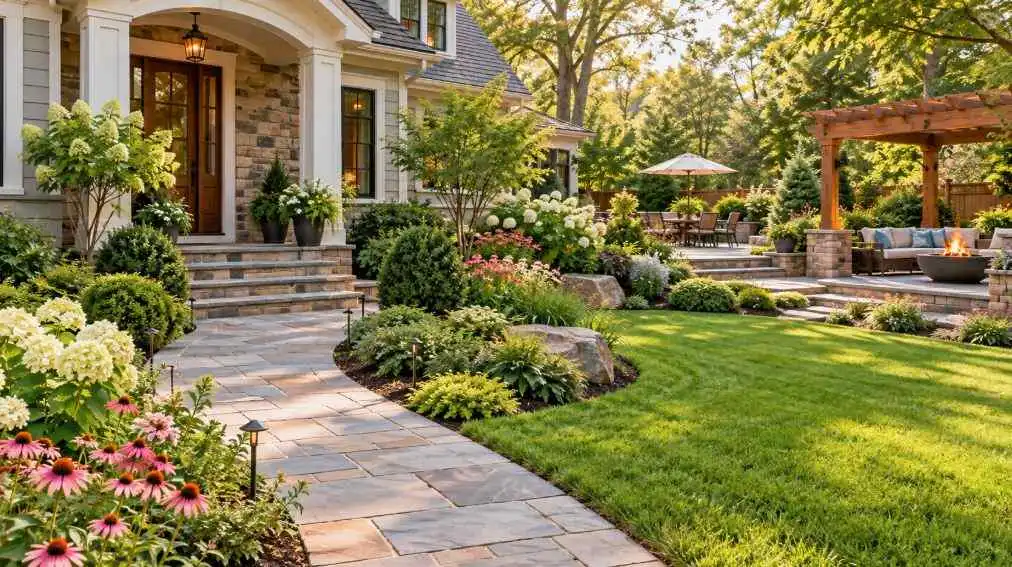
Good landscaping ideas do more than fill empty ground with plants. It gives the yard structure, makes outdoor areas easier to use, and can reduce the amount of mowing, watering, and constant tidying needed later.
The best landscaping ideas also depend on the space you actually have. A narrow front yard needs a different approach from a large backyard with a pool. A sunny, dry property should not be planted like a shaded yard with naturally moist soil.
So before buying a cart full of shrubs because they looked great at the garden center, start with the yard itself. Work with its size, sunlight, drainage, climate, and the way the space needs to function.
First, Decide What the Yard Needs to Do
A landscape becomes easier to plan when every area has a purpose.
The front yard may need a clearer walkway, better curb appeal, or less lawn to maintain. A backyard might need room for dining, children, pets, a fire pit, or a quiet seating area.
Start by marking the parts of the yard used for:
- Walking and access
- Sitting and entertaining
- Play
- Gardening
- Privacy
- Shade
- Pool activities
- Utility access
Then note where the yard gets full sun, shade, standing water, strong wind, or heavy foot traffic.
Plant choice should follow those conditions rather than fight them. The U.S. Environmental Protection Agency recommends considering climate, sun and shade, soil, water needs, and maintenance when planning a landscape. US EPA.
Front Yard Landscaping Ideas That Create a Cleaner Entrance
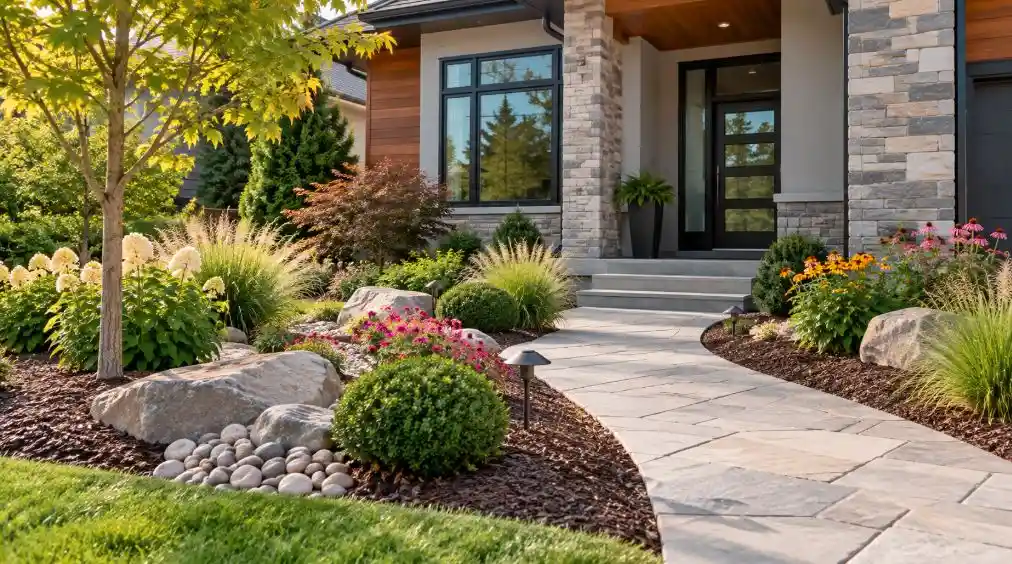
Front landscaping works best when it guides attention toward the house instead of competing with it.
A few repeated plants, defined beds, and a visible path often look more intentional than dozens of unrelated features squeezed into one space.
1. Build Simple Beds Around the Foundation
Foundation beds soften the point where walls meet the ground and can make the front of a house feel more finished.
Instead of creating one perfectly straight strip, use gentle curves or wider planting pockets where the architecture allows. Leave enough space for mature plants rather than placing young shrubs tightly against walls.
Mixing different mature heights gives the bed depth. Lower plants can sit toward the front, while taller shrubs or ornamental plants can add structure farther back.
The important word is mature. A small shrub at the garden center may not stay small.
2. Repeat a Small Number of Plants
Some of the most effective front-of-house landscaping ideas are surprisingly simple.
Repeating the same two or three plant types creates rhythm and helps the yard feel connected. It can also make maintenance easier because fewer plant types mean fewer different care routines.
Use repetition along a walkway, across a foundation bed, or on both sides of an entrance.
Avoid making both sides perfectly identical unless the architecture suits formal symmetry. Balanced does not always mean mirrored.
3. Use Rocks Where They Serve a Purpose
Front yard landscaping ideas with rocks work especially well around paths, dry areas, drainage features, or places where organic mulch would constantly wash away.
River rock, gravel, larger stones, and decorative boulders can add texture without requiring watering or trimming.
But replacing every planted bed with rock is not automatically low maintenance. Leaves, soil, and weeds can eventually collect between stones.
Rock can also absorb and release heat. The EPA warns that rock mulch in sunny locations can increase heat and water loss around plants that are not suited to hot, dry conditions.
Use stone where its durability helps, then soften it with suitable planting.
4. Mix Mulch and Stone Instead of Choosing Only One
A combination often works better than an all-rock or all-mulch yard.
Use organic mulch around shrubs and perennial beds, then reserve gravel or stone for paths, drainage strips, or decorative edges.
Organic mulch can reduce evaporation, suppress weeds, and help moderate soil temperature. As it breaks down, some organic materials also improve soil conditions. Penn State Extension.
This combination gives rock landscaping ideas more visual warmth while keeping planted areas healthier.
5. Make the Walkway Part of the Landscape
A walkway should not feel like something dropped on top of the yard.
Use planting beds, groundcover, gravel borders, or low plants to connect the path with the surrounding landscape.
For a narrow entrance, keep plants beside the path low enough that the route remains open and comfortable. In a wider front yard, a slightly broader planting area near the entrance can make the doorway feel more welcoming.
Good front landscaping ideas usually make it obvious where visitors should walk without needing signs, barriers, or a maze of stepping stones.
Backyard Landscaping Ideas That Make the Space More Useful
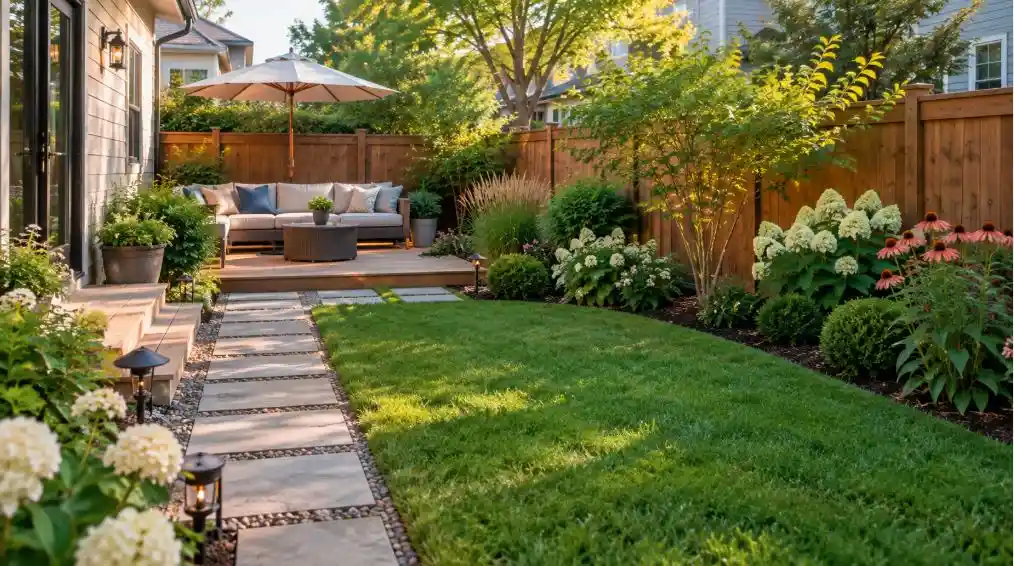
A backyard does not need one large feature to feel finished. It usually works better when several smaller areas support different activities.
6. Divide the Yard Into Outdoor Zones
Think of the backyard like an open-plan room.
One area might hold a table. Another can become a lawn or play zone. A quiet corner may work better for seating, while the far edge can hold planting for privacy.
You do not need walls between these spaces.
Changes in paving, planting, gravel, lighting, or furniture placement can create enough separation.
This approach is especially useful for simple backyard landscaping ideas because it gives existing features a clearer purpose rather than requiring a full renovation.
7. Give a Small Backyard One Strong Focal Point
A small yard can become cluttered quickly.
Instead of adding a fountain, pergola, fire pit, several garden beds, a swing, and three different paving materials, choose one main feature.
It might be:
- A compact seating area
- A specimen plant
- A small fire pit zone
- A dining table
- A raised garden bed
Keep the surrounding design quieter.
A clear focal point gives the eye somewhere to rest and can make a small backyard feel more organized.
8. Create a Gravel Seating Area
A gravel patio can be a practical alternative to covering an entire backyard with permanent hardscape.
It works particularly well around casual seating or as a transition between a lawn and garden.
Use edging to keep loose material contained and prepare the base correctly for the site. Poor preparation can turn a neat gravel area into an uneven patch that mixes with surrounding soil.
For high-traffic paths or accessibility needs, consider whether a firmer surface would be easier to move across.
9. Build the Fire Pit Area Around Safety First
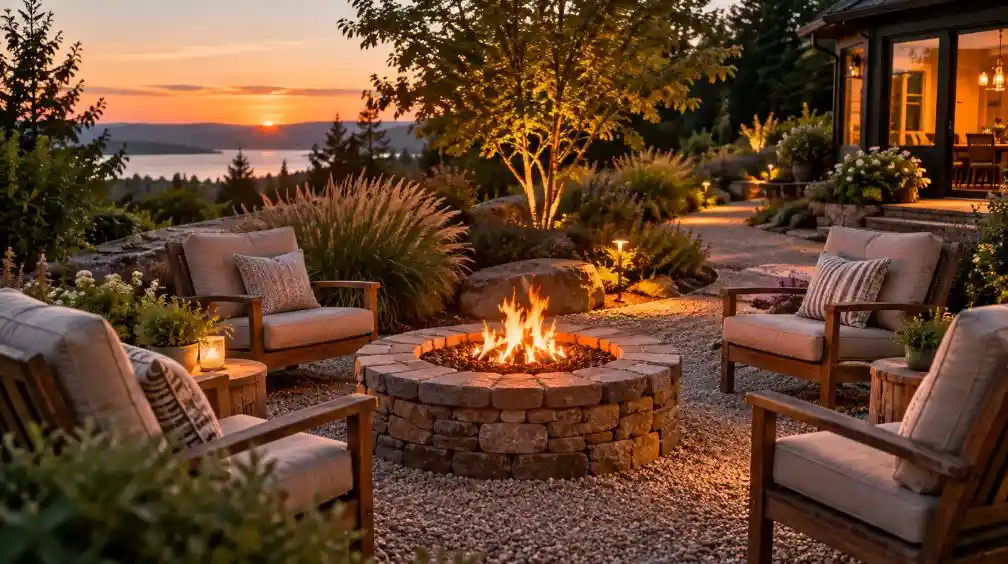
Among popular backyard fire pit landscaping ideas, the seating circle usually gets most of the attention. The location should come first.
Choose an open position away from structures and combustible materials. The U.S. Fire Administration advises using outdoor fireplaces and fire pits at least 10 feet from the home or anything that can burn. Local fire rules and the fire-pit manufacturer’s instructions may require greater clearance. U.S. Fire Administration
Once the safe position is established, create the seating area with an appropriate noncombustible or stable surface and arrange chairs so people can move around comfortably.
For small backyard fire pit landscaping ideas, a portable fire pit may offer more flexibility than a large permanent installation, but the same safety considerations still apply.
10. Use Planting to Create Privacy Without Building a Wall
Privacy does not always require a solid fence.
A layered planting scheme can block views while keeping the yard softer and more natural. Combine plants of different heights rather than relying on one uninterrupted row.
Where space is tight, a trellis or narrow vertical planting solution may take up less ground than wide shrubs.
Check mature size before planting. A privacy plant that becomes twice as wide as the available bed creates a different problem later.
11. Turn an Awkward Side Yard Into a Useful Route
Side yards are often treated as leftover space.
Instead, use them for a garden path, utility route, narrow planting bed, storage access, or a transition between front and back gardens.
Stepping stones with gravel can work in informal areas, while a solid path may make more sense for bins, wheelbarrows, bicycles, or frequent walking.
This small change can make the whole property feel more connected.
Pool Landscaping Ideas That Do Not Crowd the Water
A pool already creates a strong visual focal point. The surrounding landscape should support it rather than compete with it.
12. Soften Hard Pool Edges With Planting
Pools often come with a lot of hard material: decking, paving, fencing, and equipment.
Plants can soften those surfaces.
Instead of crowding every side, concentrate planting where it provides the greatest visual effect, such as corners, boundaries, or the area visible from outdoor seating.
Choose plants based on local conditions and consider mature spread, maintenance, and debris before placing them close to the water.
13. Give an Above-Ground Pool a Visual Base
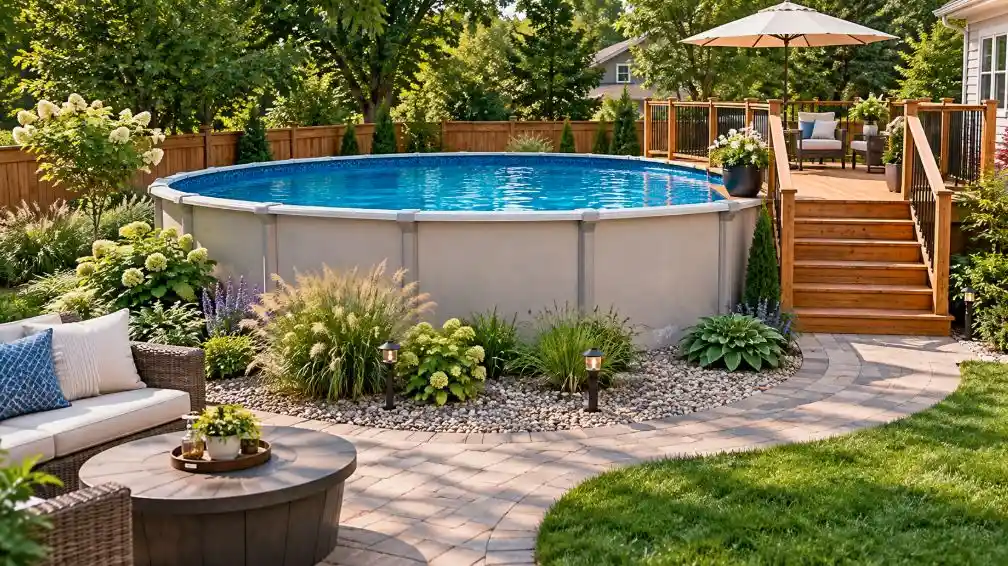
Many above ground pool landscaping ideas focus on making the pool feel connected to the rest of the yard.
A simple way to do this is to create a deliberate zone around it rather than leaving the pool sitting alone in the middle of lawn.
Depending on the site, that might include:
- A deck or defined access area
- Gravel or stone outside the pool zone
- Low planting farther from the pool wall
- A short pathway connecting the house and pool
- Seating positioned beside, rather than randomly around, the pool
Avoid covering required equipment access or making maintenance difficult.
14. Plan Drainage Before Decorative Planting
Water naturally becomes a bigger issue around pools, patios, and large hard surfaces.
Before creating elaborate pool landscaping ideas, look at where rainwater and splash-out water travel.
Permeable gravel, planted areas, or suitable drainage features may help water move into the ground rather than collect beside hardscape. The right solution depends on soil, slope, local rainfall, and construction conditions.
The EPA highlights permeable surfaces and rain gardens among approaches that can help manage water within a landscape.
If water repeatedly collects near a foundation, retaining wall, or other structure, get professional advice rather than trying to hide the problem with plants.
Low-Maintenance Landscaping Ideas That Reduce Repetitive Work
Low maintenance does not mean zero maintenance.
Plants still grow. Weeds still appear. Leaves still fall with suspicious determination.
The goal is to build a landscape that needs less unnecessary work.
15. Choose Plants for the Conditions You Already Have
Putting a sun-loving plant in deep shade creates a maintenance problem before the plant even reaches the soil.
Match plants to:
- Sun exposure
- Soil moisture
- Local climate
- Available space
- Mature size
- Water needs
In the U.S., the USDA Plant Hardiness Zone Map can help gardeners assess which perennial plants are likely to tolerate local winter temperatures. Hardiness zone is useful, but it should not replace checking sunlight, soil, moisture, and other site conditions. USDA Climate Hubs
16. Use Native and Regionally Suitable Plants Where Practical
One of the most useful low maintenance landscaping ideas is choosing plants already suited to local conditions.
The EPA recommends native and regionally appropriate plants for water-smart landscapes. Once established, suitable native plants may need less supplemental water and can be better adapted to local soil and climate than poorly matched species.
That does not mean every native plant works in every part of a yard.
A native woodland plant may still struggle in a hot, exposed bed. Match the plant to the specific site.
17. Group Plants With Similar Water Needs
A thirsty planting beside a drought-tolerant planting creates an irrigation compromise.
Grouping plants with similar water requirements makes watering easier and can reduce both overwatering and underwatering. The EPA refers to these groups as hydrozones. US EPA.
It also makes future maintenance more logical because plants with similar needs stay together.
18. Mulch Beds Properly
Mulch is useful, but more is not better.
A moderate layer can help suppress weeds and slow moisture loss. Avoid piling mulch against tree trunks or burying the visible base of woody plants.
University of Minnesota Extension recommends roughly 2 to 4 inches of mulch for many landscape situations and keeping it away from trunks and stems. University of Minnesota Extension.
Penn State also warns against the familiar “mulch volcano” piled high against a tree trunk. Penn State Extension.
19. Keep Lawn Only Where Lawn Has a Job
Removing every square foot of grass is not automatically better.
A lawn can make sense for children, pets, recreation, or a simple open area. The problem comes when narrow strips and awkward corners require mowing but provide no useful function.
Consider replacing those difficult sections with planting beds, groundcover, gravel, a path, or another surface appropriate for the site.
EPA guidance similarly recommends using turf strategically where it serves a practical purpose. US EPA
Landscaping Ideas on a Budget
A good yard does not need to be rebuilt in one weekend.
In fact, slower landscaping can prevent expensive mistakes because it gives you time to see how the property behaves through different weather and seasons.
20. Improve One High-Impact Area First
If the budget is limited, choose the area seen or used most often.
For a front yard, that may be the entrance and walkway.
For a backyard, it might be the patio or the view from the main indoor living area.
Finish that zone properly before starting five half-completed projects.
A clearly edged bed with healthy plants usually looks better than an entire yard full of unfinished ideas.
21. Spend on Structure Before Decoration
Plants and accessories are tempting because they make an immediate visual difference.
But structure often determines whether the landscape works long term.
Prioritize issues such as:
- Drainage
- Safe access
- Paths
- Edging
- Soil preparation
- Main planting areas
- Seating or activity zones
Decorative pots, lights, ornaments, and smaller accents can come later.
This approach is especially useful for easy landscaping ideas and beginner projects because it prevents decorative details from covering up practical problems.
Rocks or Mulch: Which Works Better?
Neither material wins everywhere.
| Feature | Organic Mulch | Rock or Gravel |
| Planted beds | Usually a strong option | Depends on plant and climate |
| Improves soil over time | Some types can | No |
| Suppresses weeds | Helps when used correctly | Can help, but debris may collect |
| Heat around plants | Usually lower than exposed stone | Can become hot in sunny locations |
| Needs replenishing | Yes | Less often |
| Paths and dry areas | Limited use | Often useful |
| Visual style | Soft and natural | Clean, textured, structured |
A practical landscape can use both.
Mulch may make more sense beneath shrubs and trees, while stone works well for pathways, dry zones, drainage strips, or areas where a permanent mineral surface suits the design.
How to Adapt These Ideas to Your Own Yard
Copying a beautiful yard exactly rarely works because climate, soil, house style, budget, and daily use change from property to property.
A better process is simple:
- Photograph the yard from several angles. Problems become easier to spot in a photo.
- Mark permanent features. Include doors, gates, utilities, trees, driveways, pools, and paths.
- Watch sun and water. Notice shade patterns and where rain collects.
- Choose the main function of each area.
- Select materials and plants only after the layout makes sense.
For plant selection, check reliable local resources rather than choosing only by appearance. In the U.S., the EPA provides state-based resources for water-efficient plants, while the USDA hardiness map can help narrow perennial choices. US EPA.
A landscape that fits its location will usually be easier to maintain than one designed entirely from inspiration photos.
Frequently Asked Questions
What is the easiest landscaping for beginners?
Start with defined beds, a simple path, mulch, and a small selection of plants suited to the site’s light and climate. Avoid major grading, complicated irrigation work, or large hardscape projects until the basic layout is clear.
How can I make my front yard look better without spending a lot?
Clean up bed edges, remove struggling plants, refresh mulch where appropriate, improve the entrance path, and repeat a few healthy plants instead of buying wide unrelated varieties. A tidy structure often makes a bigger difference than adding more items.
What is the lowest-maintenance type of landscaping?
Low-maintenance landscapes usually combine climate-appropriate plants, limited functional lawn, defined beds, mulch or suitable groundcover, and simple hardscape. No landscape is maintenance-free, so choose features based on how much regular care you realistically want to do.
Are rocks or mulch better for front yard landscaping?
It depends on the location. Organic mulch works well around many planted beds because it helps conserve moisture and can improve soil as it decomposes. Rock lasts longer and suits paths, dry areas, and some landscape styles, but it can become hot in full sun. US EPA.
How can I landscape a small backyard?
Give the space one main purpose first. Use a compact seating area, narrow beds, vertical planting, and a clear path rather than filling every corner. Keeping the number of materials and major features limited can also make a small yard feel calmer and more spacious.
What can replace grass in a front yard?
Depending on climate and how the area is used, options may include native or regionally suitable planting, groundcover, garden beds, gravel, permeable paths, patios, or combinations of these. Keep some lawn if it has a practical purpose rather than removing it simply because lawn-free landscaping is popular.
Build the Landscape Around the Yard You Actually Have
The strongest landscaping ideas are not necessarily the most dramatic ones. They solve real problems while making the property more enjoyable.
Start with circulation, drainage, sunlight, and how each area will be used. Then add plants and materials that suit those conditions. Rocks can simplify one part of the yard while mulch works better in another. A lawn can stay where it earns its space. A pool or fire pit can become a focal point without taking over the entire backyard.
Good landscaping should look intentional on the first day, but it should also continue to make sense after the plants grow and the novelty wears off.